The need for Continuous Personal Revelation

I invite you to read this passage and then consider how this applies today as we follow revelation from the prophets as well as our personal need for revelation.
•
The final gospel dispensation began with the calling of a prophet—Joseph Smith. As in past dispensations, God’s will is given to His children through the process of revelation. President James E. Faust (1920–2007) of the First Presidency discussed the necessity for constant revelation: “Much revelation received, in this time as well as anciently, has been doctrinal. Some of it has been operational and tactical. Much of it is not spectacular. President John Taylor reminds us: ‘Adam’s revelation did not instruct Noah to build his ark; nor did Noah’s revelation tell Lot to forsake Sodom; nor did either of these speak of the departure of the children of Israel from Egypt. These all had revelations for themselves’ (Millennial Star, 1 Nov. 1847, 323)” (“Continuing Revelation,” Ensign, Aug. 1996, 5; emphasis added).
•
President Hugh B. Brown (1883–1975) of the First Presidency described a conversation he had with a member of the British House of Commons and former justice of the Supreme Court of England, who was not a member of the Church, about the need for living prophets and the revelation they receive:
“[I said,] ‘I am submitting to you in all seriousness that it was standard procedure in Bible times for God to talk to men.’
“[He responded,] ‘I think I will admit that, but it stopped shortly after the first century of the Christian era.’
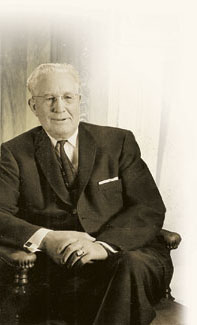
President Hugh B. Brown
“‘Why do you think it stopped?’
“‘I can’t say.’
“‘You think that God hasn’t spoken since then?’
“‘Not to my knowledge.’
“‘May I suggest some possible reasons why he has not spoken. Perhaps it is because he cannot. He has lost the power.’
“He said, ‘Of course that would be blasphemous.’
“‘Well, then, if you don’t accept that, perhaps he doesn’t speak to men because he doesn’t love us anymore. He is no longer interested in the affairs of men.’
“‘No,’ he said, ‘God loves all men, and he is no respecter of persons.’
“‘Well, … then the only other possible answer as I see it is that we don’t need him. We have made such rapid strides in education and science that we don’t need God anymore.’
“And then he said, and his voice trembled as he thought of impending war [World War II], ‘Mr. Brown, there never was a time in the history of the world when the voice of God was needed as it is needed now. Perhaps you can tell me why he doesn’t speak.’
“My answer was, ‘He does speak, he has spoken; but men need faith to hear him.’
“Then we proceeded to examine what I may call a ‘profile of a prophet.’ …
“The judge sat and listened intently. He asked some very pointed and searching questions, and at the end of the interview he said, ‘Mr. Brown, I wonder if your people appreciate the import of your message. Do you?’ He said, ‘If what you have told me is true, it is the greatest message that has come to this earth since the angels announced the birth of Christ’” (in Conference Report, Oct. 1967, 118, 120; emphasis added; see also The Profile of a Prophet, Brigham Young University Speeches of the Year [Oct. 4, 1955], 4–5, 8; or “The Profile of a Prophet,” Ensign, June 2006, 36–37, 39).
We have more need now, with the impending days of darkness that will surely come, of a living prophet that ever before. Let us remember that we sustain all of the Apostles as well as Thomas S Monson as prophets, seers and revelators, and we should heed their prophetic counsel as directly coming from God. We no longer have the luxury of picking and choosing commandments and dismissing things that the apostles counsel us to do because they are 'hard' and because we rationalize that their counsel is just counsel because they are not the president of the church. We need to listen and give heed to every word that comes from their mouth, especially those that are said in General Conference. We need that counsel!
But is it enough to depend on them to receive revelation? Can we just live on their borrowed light?
I think the answer is a resounding NO! They have diligently taught us how to seek for our own revelation. Not revelation that would contradict the things that the prophets have told us, but revelation that pertains to our specific sphere of influence. The prophet is not going to get a revelation that tells you to sell your home and downsize, or to teach a certain doctrine to your children. We are not going to find those answers spelled out to us unless we are actively seeking revelation through prayer and study. Sometimes we are given those answers directly in our minds while other times we are lead to find them in the scriptures and words of others. However the Lord chooses to lead us to that knowledge, it is all personal revelation, and it is something we should be and need to be experiencing on a daily basis.
If you are not, then there is something you need to change. I do not say this to discourage you, but to encourage you to make the change. It can happen daily and the Lord wants it to happen daily. Once it does for you, you will think, "How in the world did I function in so much darkness all of my life."
I invite you to study and consider ways that you can receive more personal revelation in your life. The following posts have talks and more information for you to study and ponder and you move forward on this quest.
How To Receive Personal Revelation
How To Receive Personal Revelation

No comments:
Post a Comment